Trust Portal
Show prospects the proof behind your proposal.
Most MSP proposals make the same claims, so prospects compare price. The Trust Portal gives them something they can check.
 Trust Portal
We’d rather show you than tell you.

Downforce Technologies chose how this page looks and which documents appear here. They cannot change a single result on it.
Checked by Assurix, not published by you.
A demo MSP (Downforce Technologies). Open the live portal

Down to the last two for a 70-user deal, Sereno walked the prospect through its live results and won against a rival holding ISO 27001 and SOC 2. Not the cheapest quote.
Win new business
How to sell with the proof.
Prospects rarely ask an MSP for proof, so bring it to them. In short: teach the gap, show your portal, leave the link. Here it is in five steps.
Step 1 of 5 · Start with their concern
Ask about the problem they want to leave behind.
A prospect changing IT provider already has a reason. Ask about it before you mention your services, Assurix or price, then stop and let them answer.
Discovery questions to askStep 2 of 5 · Explain the issue
Explain the Proof Gap, one idea at a time.
The Proof Gap is the distance between what an MSP promises and what anyone can check. Pick the one idea below that matches their concern.
There are no trust signals
Solicitors and chartered accountants must meet a standard to use the title. Anyone can call themselves an MSP.
Certificates are snapshots
A certificate describes one day, over a scope the provider chose. Between audits, nobody checks.
Service is visible. Security is invisible.
Clients see tickets and SLA reports. They can’t see MFA, patching, backups or who has access.
The MSP is the most privileged user
Nobody has more access to a client’s business. If the MSP’s standards slip, the client inherits the weakness.
Include yourself
Say the four ideas apply to you too. Leave yourself out and it sounds like an attack on their current provider. The words for each idea
Step 3 of 5 · Show the evidence
Every concern maps to something you’re held to.
Agree, then bridge with “and”, never “but”: “And the only evidence you have is what they give you.” Then open the control or live measure behind their concern.
You ask
“Last time something urgent broke, how long before someone picked up?”
Then open it on your Trust Portal
- Response SLA complianceLive95%
- Resolution SLA complianceLive92%
- EscalationControlMet
Figures from a demo MSP’s Trust Portal
You ask
“Anything that has been broken, or half-broken, for a while?”
Then open it on your Trust Portal
- Repeat problemsControlMet
Figures from a demo MSP’s Trust Portal
You ask
“When things go wrong, do you know who owns it?”
Then open it on your Trust Portal
- Client satisfaction, last 90 daysLiveOn the portal
- ReportingControlMet
Figures from a demo MSP’s Trust Portal
You ask
“When did they last call you with an idea?”
Then open it on your Trust Portal
- Catching problems firstControlMet
- Monitoring and alertingControlMet
Figures from a demo MSP’s Trust Portal
You ask
“When did they last talk to you about your plans?”
Then open it on your Trust Portal
- Linking technology to your goalsControlMet
- Quarterly reviewsControlMet
Figures from a demo MSP’s Trust Portal
You ask
“Any invoices in the last year that surprised you?”
Then open it on your Trust Portal
- BillingControlMet
Figures from a demo MSP’s Trust Portal
You ask
“When did anyone last show you a successful restore test?”
Then open it on your Trust Portal
- Critical patchingLive100%
- BackupsControlMet
- Finding and fixing weaknessesControlMet
Figures from a demo MSP’s Trust Portal
You ask
“Who at your provider can get into your systems, and how is that removed when they leave?”
Then open it on your Trust Portal
- Administrator accountsControlMet
- The provider's own management toolsControlMet
Figures from a demo MSP’s Trust Portal
You ask
“If your insurer or a client asked for evidence of your IT supplier’s security, what would you send?”
Then open it on your Trust Portal
- Your link, with its 40 security controls aligned to NCSC CAF 4.0Trustmark40/40
Figures from a demo MSP’s Trust Portal
Step 4 of 5 · Explain its scope
Say what is live and what is assessed.
Live
Refreshed every six hours from the tools you connect, such as response and resolution SLAs, client satisfaction, critical patching and supported operating systems.
Assessed
Everything else, on a set cycle, with an Assurix assessor’s sign-off.
All 59 controls must stay met.
A failure opens a 30-day window to fix it. Leave it unfixed and the Trustmark is suspended publicly. Use your portal as soon as work starts. Until you hold the Trustmark, it shows you as on the journey to becoming an Assurix Trusted MSP. What to point at
You choose how it looks. You can’t change a single result.
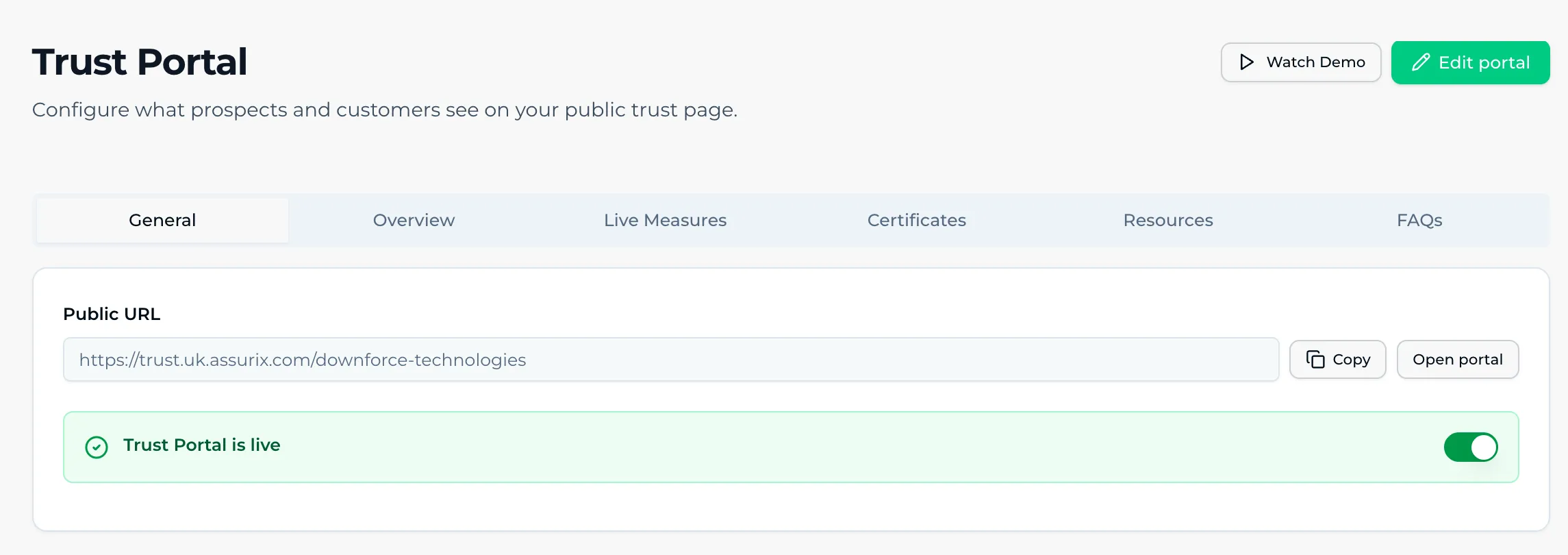
- Choose how it looks and which documents appear
- One link for prospects and clients
- Switch it live when you are ready
Step 5 of 5 · Leave the link
Leave the link, and the questions to ask any provider.
Send your link after the meeting, with questions the prospect can put to every provider on their list. The ones who can only promise will struggle to answer.
You shouldn’t have to take your IT provider’s word for it. You should be able to check.
Defend renewals
Show clients what they pay for.
A client notices a slow response. It doesn’t notice patching stopping, so at a cost review a cheaper quote can look the same.
Bring the same link to the renewal. It shows patching across your clients, SLAs, client satisfaction and your own security controls, all checked by Assurix, with each live figure naming its source. A cheaper quote then has to match the standard as well as the price. Per-client views are coming.
“Before Assurix, we were asking clients to trust our claims. Today, we’re inviting them to verify them.”
Internal metrics
Metrics measured across your own managed devices and infrastructure
| Metric | Value | Collected | Source |
|---|---|---|---|
| Resolution SLA compliance | 92% | 4 hours ago | ConnectWise PSA |
| Response SLA compliance | 95% | 4 hours ago | ConnectWise PSA |
| Supported OS compliance | 100% | 4 hours ago | Heimdal Security |
Sales resources
The words to use, step by step.
Discovery questions, scripts and proposal wording for your team.
Step 1: discovery questions
Let them describe it in their own words. Then confirm you’ve heard it. Don’t answer the question for them.
- “What made you start looking at other providers?”
- “How would you know if your IT provider had stopped patching?”
- “What could you check today, without having to ask them?”
- “When was your provider’s certificate issued, and what did it cover?”
- “If your insurer or a client asked how you vetted your IT supplier, what would you show them?”
- “Who could reach your email, files and backups right now, and how would you know?”
Step 2: the words for each idea
- There are no trust signals“Your solicitor has to meet a standard to use the title. Your IT provider doesn’t, and it has far more access to your business.”
- Certificates are snapshots“An MOT tells you the car was roadworthy on the day it was tested. It tells you nothing about this morning.”Don’t run down ISO 27001 or Cyber Essentials. They are a good foundation.
- Service is visible. Security is invisible.“You’d know straight away if nobody answered the phone. You wouldn’t know if patching had stopped four months ago.”Don’t suggest their provider is failing. You don’t know that, and nobody can tell.
- The MSP is the most privileged user“Nobody in your business has more access than your MSP. Not even you.”
- Include yourself“We hold the keys to our clients’ systems too, which is why we’re independently checked.”
Step 3: the bridge
Agree, then bridge with “and”, never “but”: “And the only evidence you have is what they give you.”
Step 4: what to point at on the portal
The live measures include response and resolution SLAs, client satisfaction, critical patching and supported operating systems. They depend on the integrations you have connected, so check your own portal before the meeting.
- The status. It shows where you stand today. A certificate shows a date.
- “They cannot change a single result on it.” Read it aloud. It answers “well, you would say that”.
- 40/40 and 19/19 met. Every control has to be met. There is no pass mark.
Step 5: questions to ask any provider
If yours isn’t the lowest quote, say so before they notice. Then ask them to request the same evidence from the others.
- “How quickly do you respond to urgent problems, and can you show me last month’s figures?”
- “Which problems keep coming back, and what do you do about them?”
- “When something goes wrong, who owns it, and how will we hear?”
- “What did you fix last quarter before a client noticed?”
- “How often will you review our IT with us, and will we get a written plan?”
- “How many critical security updates do you apply on time, and when did you last test a restore?”
- “Who at your company can get into our systems, and how is that removed when someone leaves?”
A sample proposal paragraph
Describe the Trustmark as a live status, independently checked every day, and never as a certificate.
Our security and our service are independently assessed by Assurix on 59 controls, and we have to keep meeting all of them. [x]% of tickets were answered inside our response SLA, measured from our PSA over [the period shown on our portal]. Critical patch compliance across all clients is [x]%. Repeat issues are tracked to a root cause, and we’ll walk you through the log at your first review. You’ll get a monthly service report, with client satisfaction shared at every review, and no invoice line you haven’t agreed. You can check all of this yourself at [your Trust Portal link].
For an Assurix Trusted MSP. Fill in the figures from your own portal, and keep only the measures you have connected.
Describe your status accurately
- Assurix Trusted MSP
- “We’re an Assurix Trusted MSP. Assurix independently assesses 59 controls across our security and our service, and we pass all of them.”Only Trustmark holders show the Trustmark badge, linked to their Directory listing and Trust Portal.
- On the Journey
- “We’re on the journey to becoming an Assurix Trusted MSP.”Use these words exactly. Work has started, and you don’t hold the Trustmark yet.
- Committed
- “We’ve signed up to work towards the Assurix Trustmark, with a start date booked.”You don’t hold the Trustmark yet.
We help your team sell with it.
The plan includes Sales and Proof Gap workshops, marketing packs and fortnightly office hours. How Assurix helps MSPs win more clients.

An MSP that promises, or one independently checked every day?
- Book a demo.30 minutes with Ollie. Mit joins the second call.
- Start in the month you pick.From 2 hours a week, quick wins first.
- Show prospects your live results.Share your link in proposals and at renewal.